
Who We Are
Give a Fork is an environmental non-profit based in Melbourne. We began as a charity program in 2021, and became an independent non-profit in 2026. Our founders have been working since 2018 to reduce the water, land, energy and emissions impact of our food system by assisting in the transition to sustainable protein.
We help institutions such as universities, schools and community organisations transition to lower-impact food at their events to protect Australia's Flora & Fauna.
Scroll down to find out why we focus on food to help our planet, and what people have to say about us and the practical solution we offer.





With the help of Give a Fork,
your institution or group can now access a practical (and delicious) solution that protects our environment, feeds a variety of dietary requirements and makes you a hero.

Why plant-based food?
Our focus on food, and specifically on shifting toward plant-based protein, is simple to explain.
The overconsumption of factory farmed animal protein is the problem. It uses more land, more water, more energy and produces more emissions than plant-based alternatives, which can be nutritionally equivalent. Below, we explore the evidence backing these claims, and offer you a delicious solution to these realities.
The underlying issue is the efficiency of plant-based vs animal-based protein. When we eat animals we are funneling plant protein through a living creature: Globally, delivering 100 grams of protein as beef generates more than sixty times the greenhouse gas emissions of delivering the same protein as peas, whilst occupying nearly fifty times the amount of land [¹].
Food is a top single-industry contributor to global emissions.
Producing the world's food generates around a third of all human-caused greenhouse gas emissions. Roughly two-thirds of that comes from animal-based food, against about one-third from plant-based food, even though plants are responsible for providing most of the world's calories. [¹].
The UN's Food and Agriculture Organization puts livestock's direct production emissions at 6.2 billion tonnes of CO₂-equivalent a year, about 12% of all human-caused emissions, with cattle responsible for 62% of that total. It also projects demand for animal products rising around 20% by 2050, if we do nothing to prevent the rise, taking livestock emissions toward 9.1 billion tonnes [²].
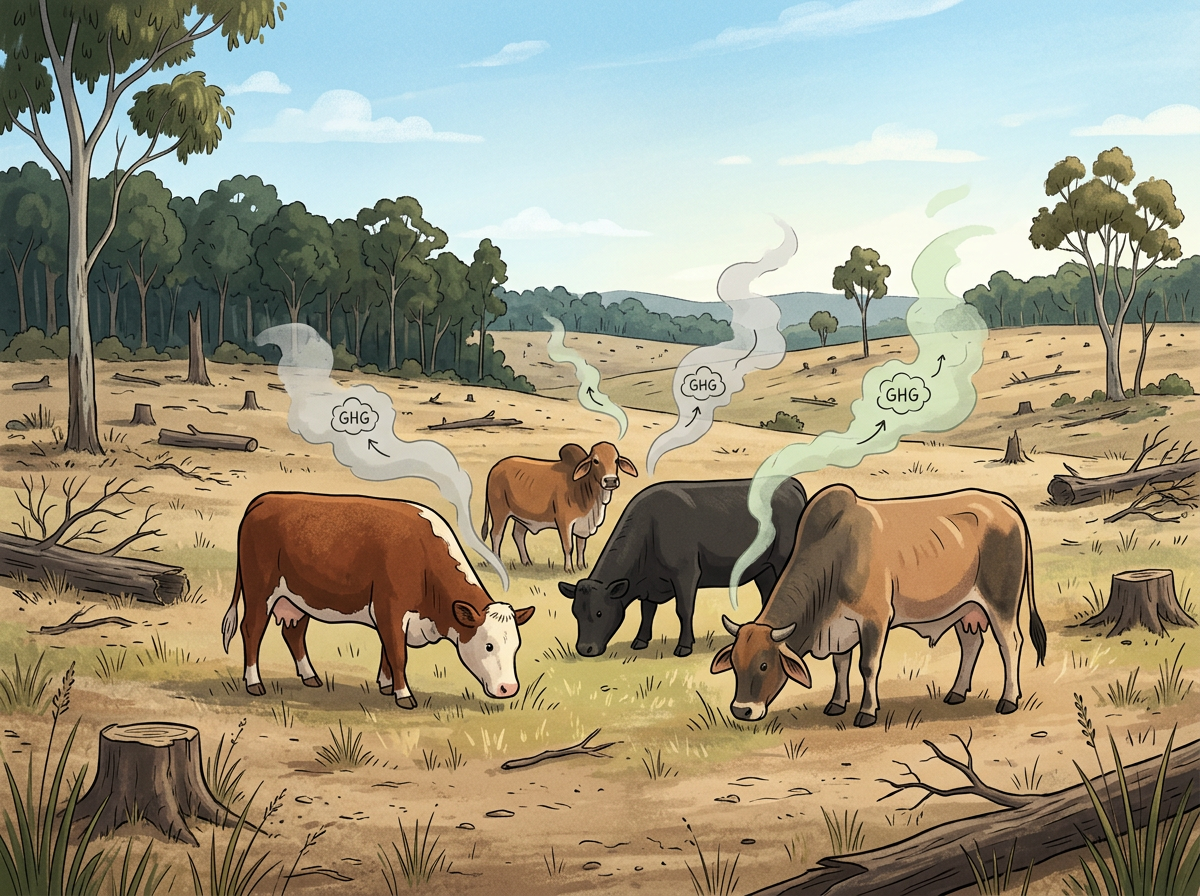
12% of all human-caused greenhouse gas emissions come from livestock. Cattle alone account for 62% of that[²].
Our land is limited.
Emissions are only part of it. A 2021 Chatham House report, supported by the UN Environment Programme, found the global food system is the primary driver of biodiversity loss worldwide. Agriculture is the identified threat to 24,000 of the 28,000 species currently at risk of extinction, which is 86% of them [³].
That report set out three actions that have to happen together: shift dietary patterns toward more plant-heavy diets, protect and return land to nature, and farm in more nature-friendly ways. It puts dietary change first, because the more that happens, the more room there is for the other two. Land cannot be returned to nature while demand keeps requiring it for food [³].
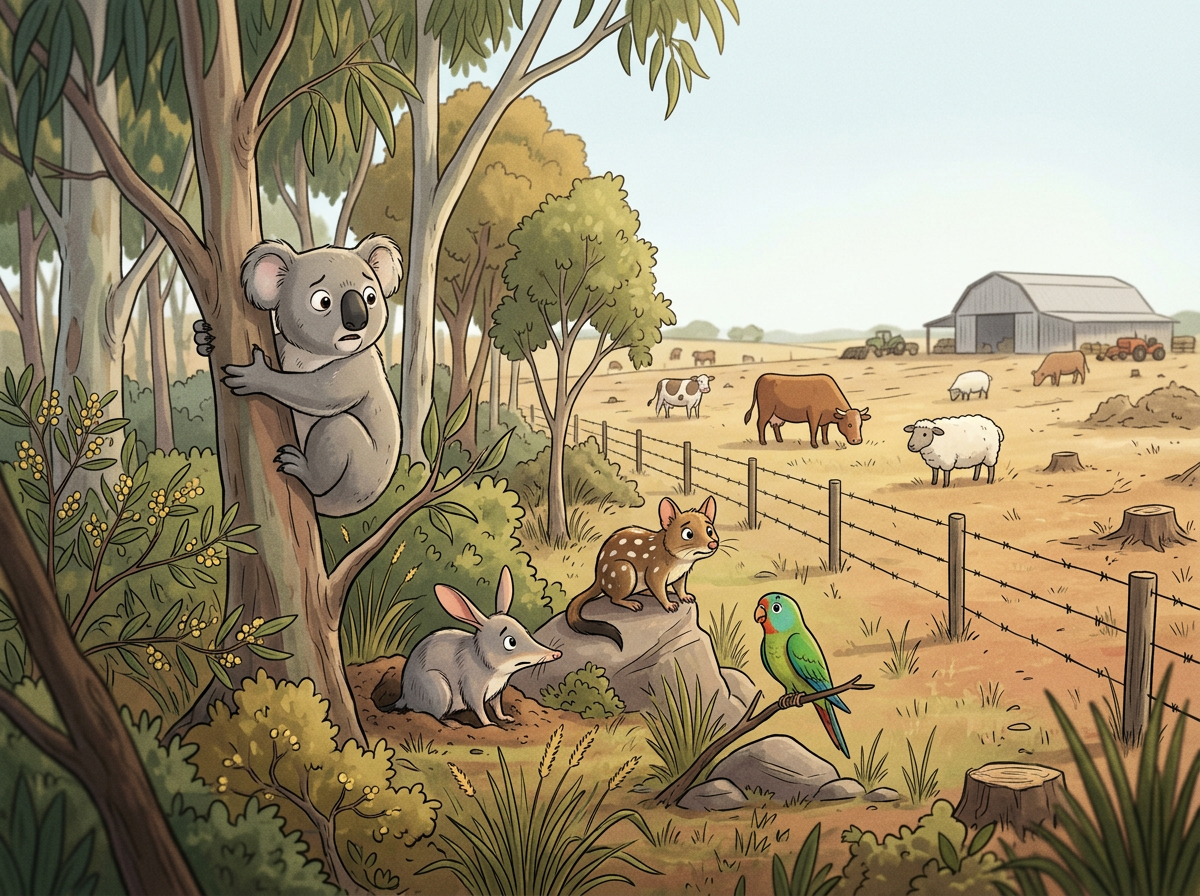
86% of species at risk of extinction are threatened by agriculture [³].
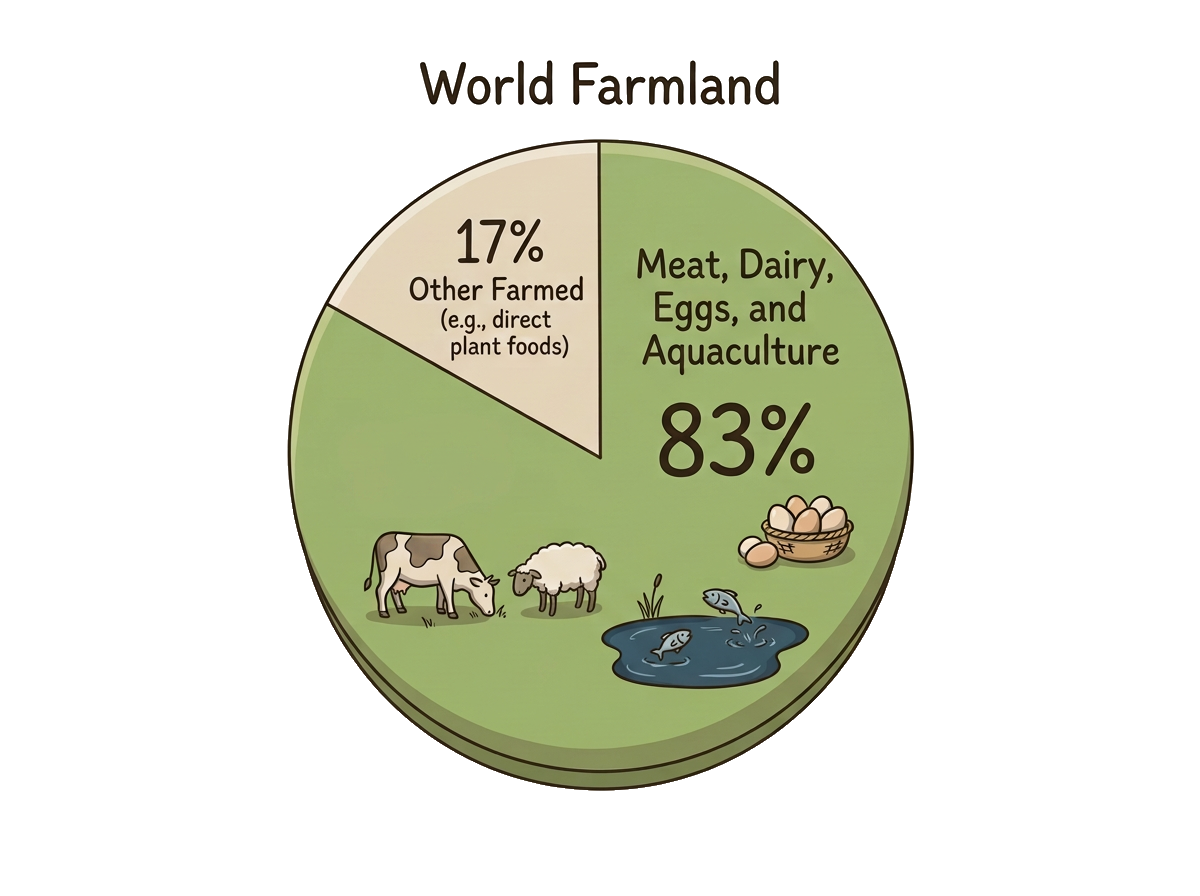
83% of the world's farmland is used for meat, dairy, eggs and aquaculture [¹].
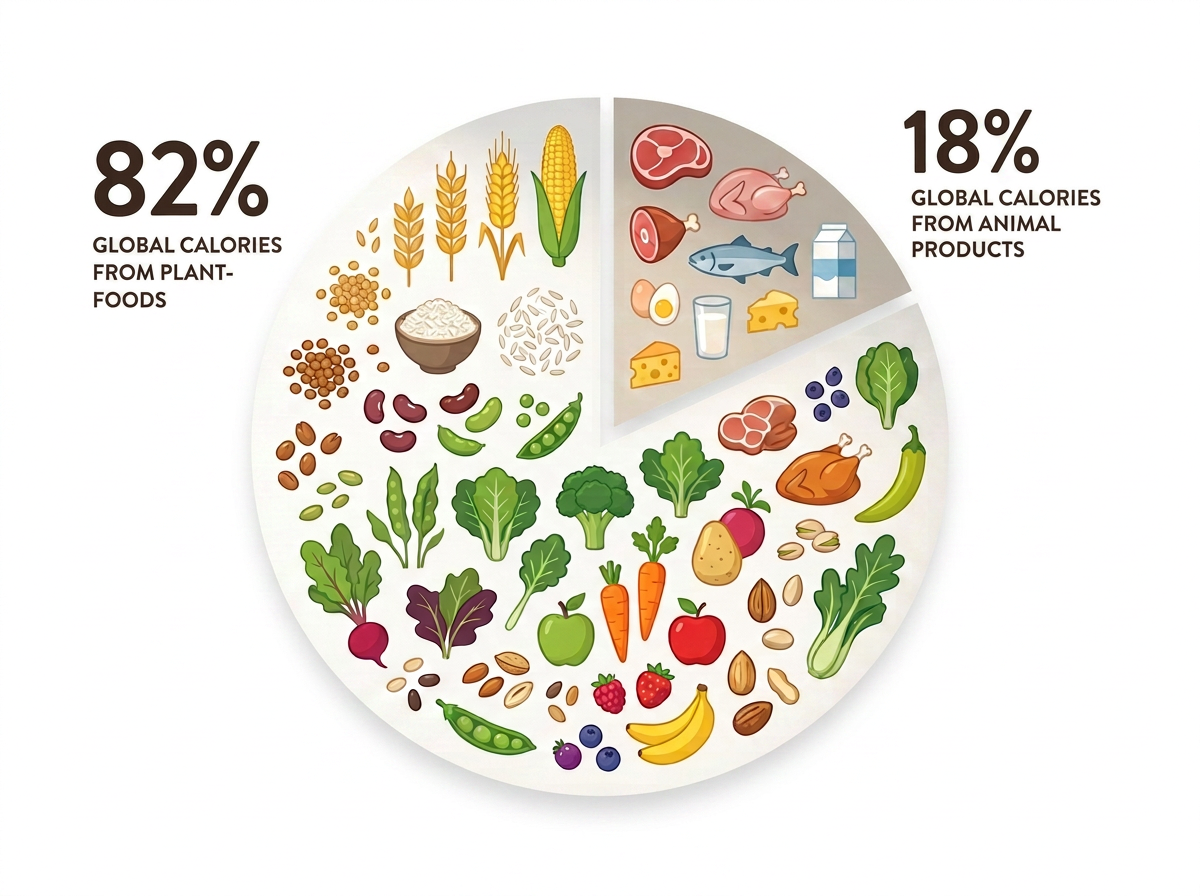
Animal Foods provide only 18% of the world's calories in return [¹].
Does changing my diet actually make a difference?
In 2018, researchers at Oxford and Agroscope published the largest analysis of food production ever assembled: 570 life-cycle assessments covering more than 38,000 farms across 119 countries and 40 products, roughly 90% of everything the world eats. It remains the reference dataset for this field [¹].
Its finding on diet was clear. Moving from current global diets to one without animal products would cut food's land use by 76% and its greenhouse gas emissions by 49% [¹].
In 2023, an Oxford team tested this against real diets rather than models, measuring what 55,504 people in the UK actually ate. Vegan diets produced about a quarter of the greenhouse gas emissions of high meat diets; a reduction of roughly 75% [⁴]. You didn’t need to go vegan to see the effect: people eating small amounts of meat still came in at least 30% below heavy meat-eaters across most environmental measures.
What makes food change the most powerful lever for individuals and institutions?
Switching to renewable electricity reduces emissions. Driving less reduces emissions. Showering less reduces water. Living in a 5 bedrooom share house reduces your land use. All of these changes matter enormously for our environment, but food touches all of these and is practical.
Changing what is on a plate can reduce greenhouse gases, land occupation, water pollution, deforestation and biodiversity loss at the same time, because how we choose to eat is the common thread running through all of them. Joseph Poore, who led the 2018 Oxford study, made exactly this point: a plant-based diet is probably the single biggest way to reduce your impact on the planet, and it is bigger than cutting flights or buying an electric car because those only reduce greenhouse gases [⁵].
That is the claim we make. Food is the one single lever that reduces the widest range of environmental problems in a single motion. Get the pork off ya fork!
References
Poore, J. & Nemecek, T. (2018). Reducing food's environmental impacts through producers and consumers. Science 360(6392), 987–992. DOI: 10.1126/science.aaq0216
https://www.science.org/doi/10.1126/science.aaq0216FAO (2023). Pathways towards lower emissions: a global assessment of the greenhouse gas emissions and mitigation options from livestock agrifood systems. Food and Agriculture Organization of the United Nations.
Livestock share of global emissions, cattle share, projected demand growth to 2050.
Benton, T. et al. (2021). Food System Impacts on Biodiversity Loss. Chatham House, supported by the UN Environment Programme.
Food systems as the primary driver of biodiversity loss; 86% of at-risk species; the three levers, with dietary change first.
Scarborough, P. et al. (2023). Vegans, vegetarians, fish-eaters and meat-eaters in the UK show discrepant environmental impacts. Nature Food 4, 565–574.
Measured diets of 55,504 people; the gradient between high and low meat diets. UK diets and UK sourcing.
Carrington, D. (2018). Avoiding meat and dairy is 'single biggest way' to reduce your impact on Earth. The Guardian, 31 May 2018.
Joseph Poore's remarks on why dietary change is broader in effect than transport or energy changes. These are the researcher's comments to the press, not a finding stated in the paper itself.
Testimonials

“We’ve had the pleasure of working with Give A Fork facilitated catering for the past few years, and I can’t say enough about the incredible service they provide. They are approachable, quick to respond to any questions, and always attentive to our needs. Their dedication to offering a variety of sustainable food options has truly made a difference at our events. From the smooth deliveries to the hands-on support during the events, every detail is handled with care and professionalism. The low prices from their recommended suppliers have also been a game-changer, making sustainable choices more accessible.
The food isn't just sustainable—it's also incredibly tasty! From the Bao Buns to the stir-fry, we've tried it all, and everything is consistently delicious. It's always well-received and greatly appreciated by both students and staff. It’s evident that Give A Fork is deeply committed to creating a positive impact, both in terms of sustainability and inclusivity. I’m genuinely grateful for everything you do, and the way your services elevate our events is something we truly appreciate!”
Anh Pham
- The University of Melbourne Faculty of Science

“Over 2024, Give a Fork has consistently facilitated sustainable catering for a variety of events held by the University of Melbourne Student Union (UMSU). The Give a Fork team, led by Jack and Mei, have been invaluable to UMSU’s goal to provide free meals to students whilst also reducing environmental impact.
Give a Fork is dedicated to their organisational objectives with Jack and Mei always working well beyond what is expected. Jack and Mei have been always eager to volunteer their time, be it through cooking on the grill, serving students or providing prompt, friendly and reliable delivery, along with sustainability statistics.
UMSU, as a not-for-profit, has limited resources. Generally, we must find a balance between our goals of reducing environmental impact and serving as many students as possible. However, with Give a Fork facilitating services and products at an affordable rate, we have been able to do both to an extent simply not possible without their input.
The last thing to note is that UMSU represents a large and diverse student body with a broad array of dietary requirements. The plant-based alternatives provided through Give a Fork have meant that no student is left out, all can come and have a free meal regardless of their dietary needs. The consistent praise we hear from students at events facilitated through Give a Fork demonstrates how fundamental Jack and Mei have been in showing students that plant-based meals are of the same, if not higher, quality than traditional alternatives, are significantly better for the environment, and are the best way forward for our planet.”
Joshua Stagg
- University of Melbourne Student Union (UMSU) President

“Give A Fork has become the go-to choice for RMIT UP's student events, and it's easy to see why. Their commitment to providing sustainable and accessible food options aligns perfectly with our values and demonstrates the environmental impact. Choosing Give A Fork was a straightforward decision for us. Their food they help to provide is not only incredibly tasty and affordable, but it also receives rave reviews from everyone who attends our events. The team at Give A Fork is exceptionally helpful, and having them on-site to assist us is a fantastic bonus. Embracing sustainable eating habits is one of the simplest yet most impactful actions we can take for the planet, and Give A Fork is leading the charge. We can't recommend them highly enough!”
Matt Cox
- RMIT UP

“We’ve had the pleasure of working with Give a Fork for the past few years and we have loved every moment of it. Not only have they provided us with delicious and sustainable food options, but the team from Give a Fork have gone above and beyond, offering assistance with every detail, from food deliveries to helping manage logistics on-site.
Their help has enabled our events to run super smoothly. The food options are also so diverse and can suit any theme. We have been able to make our events more inclusive by catering for a wide range of dietary preferences. Another standout aspect of working with Give a Fork has been their ability to facilitate low cost food, which made it possible to offer high-quality, sustainable meals without breaking our budget. Our students have also really enjoyed the variety and quality of food provided - we always receive such positive feedback.
Give a Fork has truly helped us elevate our events, making them more sustainable, inclusive, and memorable. We look forward to continuing this partnership for many events to come!”
Elise Redmond
- Monash University (Peninsula) Student Union

“I can’t speak highly enough of Give A Fork! Jack and Mei have built an incredible service that empowers us all to make a positive eco-difference - without ever compromising on flavour! Their sustainable food facilitation is consistently delicious, and their team is warm, approachable, and a joy to work with.
They bring enthusiasm, collaboration, and a willingness to explore new ideas to every event. When I needed 600 serves of Bao Buns cooked and served within just two hours, I thought I was asking the impossible. Two days later, I receive a photo of Mei and a 6ft steamer, ready to go! Their commitment to going above and beyond to help in delivering sustainable events ensures that everything runs smoothly, making the entire process seamless and stress-free. Their cost-friendly food has been a lifesaver during the cost-of-living crisis, making sustainable, high-quality catering more accessible - whilst always maintaining generous portion sizes without cutting costs.
Give A Fork is truly special, and I can’t recommend them enough. Whenever we have Give a Fork, our students always leave with a big smile! I look forward to continuing to serve our students delicious, sustainable food with an impact!”
Georgia Bettoli
- Melbourne Polytechnic

“VCE Summer Tutoring is a youth-led and volunteer-run education charity that delivers a two-week summer school program for disadvantaged high school students across Victoria in January of each year. Since our first program in 2024, Give a Fork has been a generous and diligent supporter of our social mission and our community through their provision of delicious vegan BBQ meals for our students and volunteers.
For a bunch of kids with diverse dietary needs like ours, Give a Fork’s plant-based menu is vital to keeping meals inclusive to all – and you know it tastes good when there’s people going up for seconds and even thirds!
As a new organisation that runs solely on volunteer efforts and community support, we deeply appreciate Give a Fork’s emphasis on affordability, which allows us to deliver sustainable food options to underprivileged students at little to no cost.
Jack and Mei are always a pleasure to work with – efficient in their delivery and friendly in their disposition. We look forward to continuing to work with Give a Fork in the future in carrying out our shared goal of promoting a world that’s kinder to people, to animals and to the environment.”
Program Directors
- VCE Summer Tutoring
“We’ve been lucky enough to have Give a Fork organise catering at a couple of events now and it has been a true success. They are able to scale up or down depending on the scope of the event and help to provide sustainable food options that are not only delicious but also leave the world a little bit better off. It is difficult to find food suppliers for larger events that can manage to balance being sustainable with reasonable pricing and Give a Fork’s suppliers manage to remain pretty unbeatable on both fronts.
Jack and Mei are always super easy to work with and have made the process a breeze, approaching our events with care and genuine passion. I couldn’t recommend them highly enough (and have already done so many times!).”
Lewis Kidson
- Victoria University